 (1)-1778922009.jpg)
- Traditionally, Nakuru has experienced significant political shifts and conflicts. This was after KANU took all the seats in the 1963 elections.
- During the one-party era (1960s–1980s), Kikuyu leaders wielded significant power, supported by major land-buying companies.
- The return of multi-party democracy in 1992 marked a significant transition, leading to increased ethnic violence and ongoing political realignments.
- Devolution, which was introduced in 2013, saw the rise of the first two governors from the Jubilee Party
Nakuru County is one of Kenya's most politically volatile and influential areas. The county covers 7,496.5 km², had a population of 2,162,202 in the 2019 Census, and 1,054,856 registered voters in 2022. Its 11 constituencies consistently influence national politics namely:
- Nakuru Town West
- Nakuru Town East
- Bahati
- Subukia
- Rongai
- Molo
- Njoro
- Gilgil
- Naivasha
- Kuresoi North
- Kuresoi South
Transition from KANU to Multi-Party Instability
Traditionally, Nakuru has experienced significant political shifts and conflicts. This was after KANU took all the seats in the 1963 elections. Especially with party strongmen including Ramogi Achieng-Oneko in Nakuru Town and Fred Kubai in Nakuru East. Subsequent decades saw KANU's dominance until the rise of multi-party politics.
During the one-party era (1960s–1980s), Kikuyu leaders wielded significant power, supported by major land-buying companies. Examples of Mark Mwithaga, a long-serving Nakuru Town MP, as well as Kihika Kimani, who rose to prominence in 1974,
The Kalenjin on the other hand have been gaining greater representation in the western parts. Willy Komen's win in Nakuru West in 1969 was just a highlight.
Read More
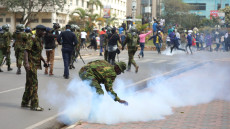
The fought for return of multi-party democracy in 1992 marked a significant transition, leading to increased ethnic violence and ongoing political realignments.
Just like the rest of the counties 2007 post-election violence was brutal in Nakuru. Mostly intensifying the Kikuyu-Kalenjin conflict. Central and southern constituencies are mainly Kikuyu, while western ones are mostly Kalenjin.
The Jubilee Era and Its Dominance (2013–2022)
Devolution, which was introduced in 2013, saw the rise of the first two governors from the Jubilee Party
The first , Kinuthia Mbugua (2013–2017) who laid the foundation for the county structure.
Then followed Lee Kinyanjui (2017–2022) a major infrastructure developer. He oversaw Nakuru's elevation to city status in 2021.
His maximum political influence was seen in the 2017 presidential re-election, when Uhuru Kenyatta received 638,721 votes (98.11%) out of 651,017 valid votes, with 949,971 registered voters. Raila Odinga, who boycotted this election, received just 428 votes (0.07%).
At that time, Susan Kihika was serving as a senator and building the political profile that would lead her to run for governor in 2022. This was after she became the first female Speaker of the Nakuru County Assembly (and one of the early county assembly speakers after Kenya's devolution in 2013). She held the position during Governor Kinuthia Mbugua’s term and was later succeeded around 2017.
A New Age
Unto the 2022 election which marked a crucial transition in a political party's domination.
President William Ruto’s United Democratic Alliance (UDA) replaced Jubilee's dominance in Nakuru. This boldly redefined the political landscape after a long Jubilee era in the county. Ruto had 455,632 votes (65.9%) for the presidency in the county.
Susan Kihika won the governorship with 440,704 votes (64.6%) as Tabitha Karanja won the Senate seat with 442,864 votes (68.1%).
UDA's win was capitalised on anti-Jubilee sentiment, historical land grievances, and the "hustler" narrative, drawing many Kikuyu voters who had supported Uhuru Kenyatta in 2017. UDA's influence reached beyond the 11 constituencies, strengthening Ruto's Rift Valley base.
Persistent Political Issues
From land to ethnic societies and national collaborations, these factors have shaped Nakuru's political atmosphere.
Central and southern constituencies, like Naivasha, Gilgil, Bahati, and Subukia, remain largely Kikuyu, while the west, including Rongai, Kuresoi North, and Kuresoi South, is predominantly Kalenjin.
From KANU dominance to multi-party instability, then Jubilee, and now the UDA era, Nakuru has repeatedly transitioned between ruling parties. Voters often change allegiance in response to shifts at the national level.
Under Governor Susan Kihika and UDA, Nakuru remains a major political prize. It is worth noting that, historically, changes in Nakuru have preceded shifts in Kenya's broader political landscape.
As we look unto the 2027 general elections with the return of Jubilee and the different political shift after The Late Raila Odinga's death be sure to catch the next series as we break down Nakuru Town West.
Stay connected with us on WhatsApp and Facebook for instant updates and breaking news as it happens.