
These twin legislative frameworks released by the Ministry of Agriculture and Livestock Development aim to modernize Kenya's farming sector through technology.
The Cabinet Secretary (CS) for Agriculture and Livestock Development Mutahi Kagwe is formally inviting Kenyans to take part in public participation forums on the Draft Agricultural Data, Information and Digital Policy 2026 and the Draft Digital Agricultural Information Bill 2026.
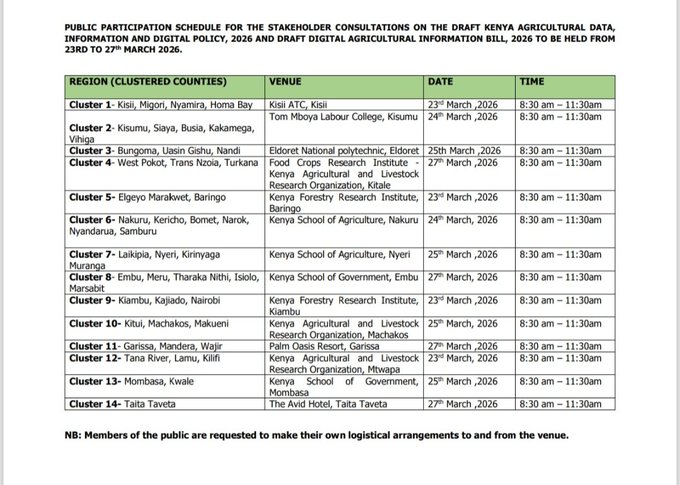
"We call upon Kenyans and the general public to participate and share their views during the nationwide public participation forums on the Draft Agricultural Policy & Bill 2026, scheduled from 23rd to 27th March 2026 as outlined in the schedule below."
Read More
These twin legislative frameworks released by the Ministry of Agriculture and Livestock Development aim to modernize Kenya's farming sector through technology.
1. Draft Agricultural Data, Information and Digital Policy 2026
This policy lays out Kenya’s strategic vision for adopting digital technologies across agriculture, livestock, fisheries, and irrigation.
Unified Data Systems: It proposes a secure national platform to harmonize agricultural data across the value chain.
Fixing Fragmentation: It tackles the problem of disconnected digital platforms and data silos that hinder coordination.
Infrastructure & Access: It promotes rural broadband expansion, device subsidies (like smartphones), and a shift from traditional extension services to digital tools such as SMS and chatbots.
Inclusive Access: It prioritizes access for women, youth, persons with disabilities, and marginalized communities in ASAL regions.
2. Draft Digital Agricultural Information Bill 2026
This bill provides the legal foundation to implement the policy’s goals.
KADIC Creation: It proposes establishing the Kenya Agricultural Digital Information Centre (KADIC).
Core Functions: KADIC will manage the integrated data system and coordinate digital platforms nationally.
Innovation Hub: It will host a national hub to incubate and scale AgriTech innovations.
Data Governance: The bill sets legal standards for data privacy, security, and ethical use.
System Interoperability: It mandates technical standards to ensure seamless data sharing between public and private systems.
Alignment with National Priorities
The policy aligns with national priorities under the Ministry of Agriculture and Livestock Development. At its core are food security, employment, and economic growth. These goals are expected to be supported through modern digital systems and unified data platforms that connect the sector more effectively.
Benefits for Farmers and Rural Communities
For farmers, fishers, pastoralists, and cooperatives, the changes could be practical and far-reaching. Access to extension services, real-time market prices, weather alerts, subsidy updates, livestock traceability, disease warnings, irrigation guidance, and financing options will be delivered through mobile-enabled platforms.
Addressing Fragmented Information Systems
One of the key challenges the policy seeks to address is fragmented information. By creating an integrated digital ecosystem, the system aims to reduce delays, eliminate duplication, and improve reliability.
This is expected to cut post-harvest losses, reduce waste, strengthen supply chains, improve exports, and build resilience against climate shocks.
Inclusion and Devolution
Inclusion is also a major focus. The policy recognizes the need to support women, youth, persons with disabilities, and communities in Arid and Semi-Arid Lands (ASALs). At the same time, it reflects Kenya’s devolved governance structure, where counties handle local delivery while the national government provides coordination and standards.
Vision for the Agricultural Sector
Ultimately, the vision is to raise productivity, improve incomes, and strengthen value chains while enhancing food security. Digital tools and data systems are at the center of this transformation.
How Kenyans Can Participate
Kenyans can still participate by sending submissions to [email protected] (cc: [email protected]). One can also make written submissions, or attending regional forums before the March 27, 2026 deadline.
Constitutional Backing and Public Engagement
Beyond policy drafting, the process reflects Article 10 of the Constitution on public participation. It also builds on consultations with government, the private sector, and other stakeholders.
Stay connected with us on WhatsApp and Facebook for instant updates and breaking news as it happens