

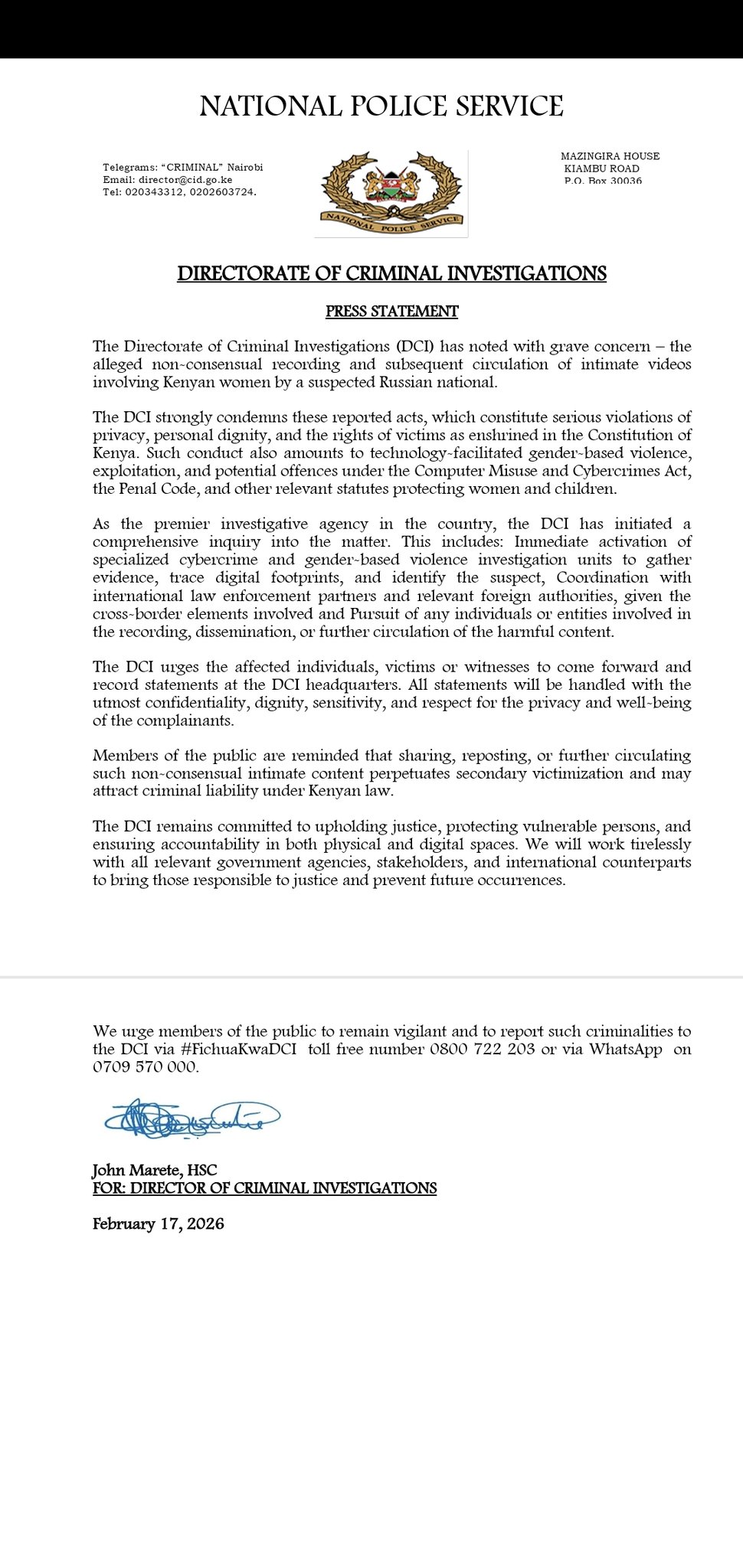
- In a press statement issued on February 17, 2026, the DCI described the allegations as a “grave concern,” stressing that the acts represent a severe breach of personal dignity and a violation of constitutional rights.
Kenya’s Directorate of Criminal Investigations (DCI) has launched a comprehensive inquiry into a suspected Russian national accused of orchestrating a systematic campaign of privacy violations against Kenyan women.
Videos have been circulating online showing the individual luring women to his residence, secretly recording intimate encounters without their consent, and distributing the footage across digital platforms.
In a press statement issued on February 17, 2026, the DCI described the allegations as a “grave concern,” stressing that the acts represent a severe breach of personal dignity and a violation of constitutional rights.
Kenya’s Computer Misuse and Cybercrimes Act (2018) squarely addresses the alleged conduct.
- Section 37 criminalizes wrongful distribution of intimate images, punishable by fines up to Ksh 200,000, imprisonment for up to two years, or both.
- Section 27 on cyber harassment imposes heavier penalties—fines up to Ksh 20 million and prison terms of up to 10 years—if distribution was intended to threaten or cause emotional distress.
The actions also violate Kenya’s Data Protection Act (2019), which prohibits non‑consensual processing of biometric and private imagery.
Enforcement and Public Safety
The DCI’s Cybercrime and Gender‑Based Violence (GBV) units are deploying forensic tools to trace the digital footprint of the distributed content. Given the suspect’s alleged foreign nationality, Kenyan authorities are coordinating with international law enforcement.
"As the premier investigative agency in the country, the DCI has initiated a comprehensive inquiry into the matter. This includes immediate activation of specialized cybercrime and Gender Based violence investigation units to gather evidence, trace digital footprints, and identify the suspect," said the DCI.
The DCI has issued a stern warning: sharing or reposting the videos is a criminal offense that contributes to secondary victimization. Victims are encouraged to report to DCI headquarters, where officials promise “utmost confidentiality, dignity, and sensitivity.”
"Members of the public are reminded that sharing, reposting, or further circulating such non-consensual intimate content perpetrates secondary victimization and may attract criminal liability under Kenyan Law," said the DCI.
Information can be shared via the toll‑free line 0800 722 203 or through the official WhatsApp channel at 0709 570 000.
Stay connected with us on WhatsApp and Facebook for instant updates and breaking news as it happens.