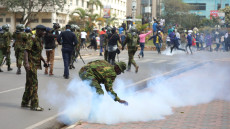
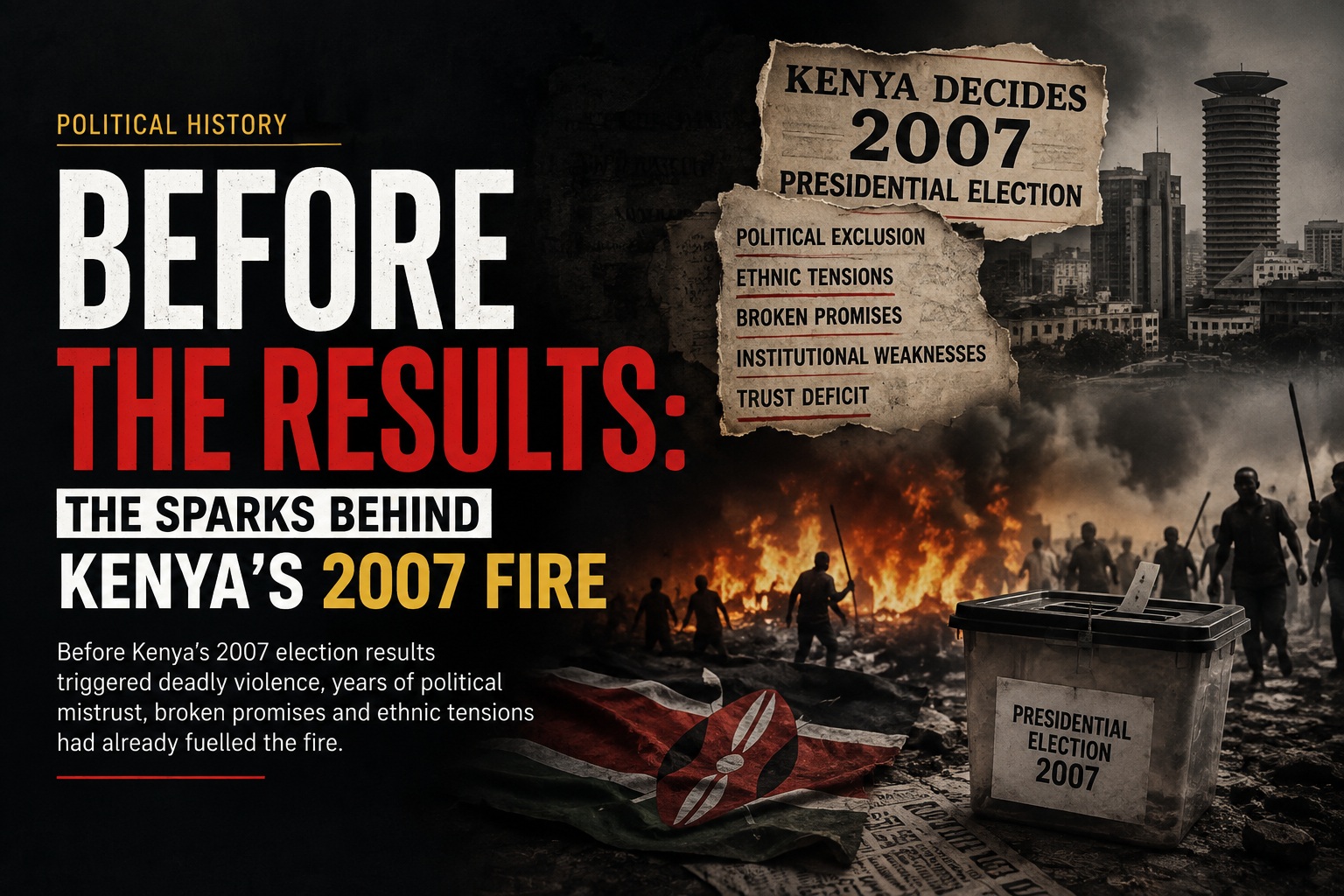
The disputed announcement of Kenya’s 2007 presidential election results is often remembered as the moment the country descended into violence. But the fire did not begin there. Years of political mistrust, broken agreements, institutional weaknesses, ethnic rhetoric and unresolved grievances had already created the conditions for a national crisis. Understanding those sparks remains crucial to understanding what followed.
People in Kenya to this day refer to '2007' in a low, serious tone. For many younger Kenyans and even for some who experienced it firsthand, the tragedy is generally recalled only as a lesson about 'tribal politics' or contested elections. Very few people can explain the immediate cause that ignited the country that evening on 30 December 2007.
The Explosive Fuel Already Stacked
The announcement alone did not cause the wildfire; by that time, the political atmosphere was already full of complaints and distrust. Three underlying problems contributed to the situation:
1. A referee who no one trusted
Before the election, Kibaki unilaterally appointed all 22 commissioners of the ECK. He did this, disregarding the 1997 agreement between the Inter-Parties Parliamentary Group (IPPG), which required consultation with opposition parties to ensure the commission's neutrality.
Read More
It is therefore undeniable, that the action had undermined the ECK's independence and severely harmed public confidence in the electoral process without a single vote having been cast.
2. A broken promise from 2002
In 2002, the National Alliance Party of Kenya (NAK), led by Kibaki, and Raila Odinga's Liberal Democratic Party (LDP) signed a Memorandum of Understanding with a view to forming the National Rainbow Coalition (NARC) to unseat the long-ruling KANU.
The agreement provided for a 50-50 split of power and created a position for Odinga as Prime Minister. Nevertheless, after NARC won, Kibaki ignored the agreement, appointed his own supporters, and did not establish the post.
The former allies grew increasingly bitter, and by 2007 their bitterness had become a defining feature of Kenya's political scene.
3. Weaponised tribal rhetoric
The campaign also made the discussion about Majimboism, that is, regional devolution, turn into an ethnic issue.
Odinga's Orange Democratic Movement presented Majimboism as a means of tackling economic inequality and of granting more power to disadvantaged regions. At the same time, Kibaki's Party of National Unity saw it as a threat which could result in tribal balkanisation.
In parts of the Rift Valley, local politicians pushed the rhetoric further, suggesting that an ODM victory would make it possible to “reclaim” land from communities viewed as outsiders.
Many believed that the elite political group had stolen their votes, which led to an immediate and violent reaction. The reaction was immediate and explosive.
What the Official Inquiries Found
In certain areas the violence was a spontaneous response to the belief that the election had been stolen, while in other places it soon turned into an organized and ethnically directed action, frequently involving local politicians and business leaders.
Under all that were deeper grievances concerning land and stemming from history. The fact that presidential power was concentrated and a long-standing culture of impunity connected with violence related to elections.
It was clear that the announcement in question had served as the trigger, but the fuel for the situation had been accumulating over several years.
Why This History Matters
It is not merely an academic exercise to understand exactly how the violence of 2007 started.
It is a matter of distinguishing between viewing political violence as an unavoidable 'tribal' curse and acknowledging it as the consequence of identifiable institutional failures, broken political agreements, and the deliberate use of identity for political advantage.
The final days of December 2007 remain one of the clearest examples in modern Kenyan history of how quickly a contested election can lead to a breakdown of national unity when it is held against a backdrop of deep-seated and unresolved grievances.
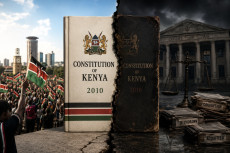
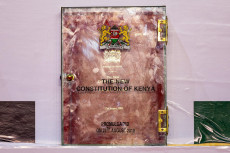
Since then, Kenya has carried out reforms aimed at avoiding a recurrence: it has introduced a new Constitution, reorganized its electoral body, and established stronger legal frameworks. Yet the public needs to remember precisely how that original spark was started.
History doesn't automatically repeat itself, but if the same structural weaknesses are neglected it can start to seem as if the first thing you need to do to make certain that the fire never starts again is to know precisely how it began.