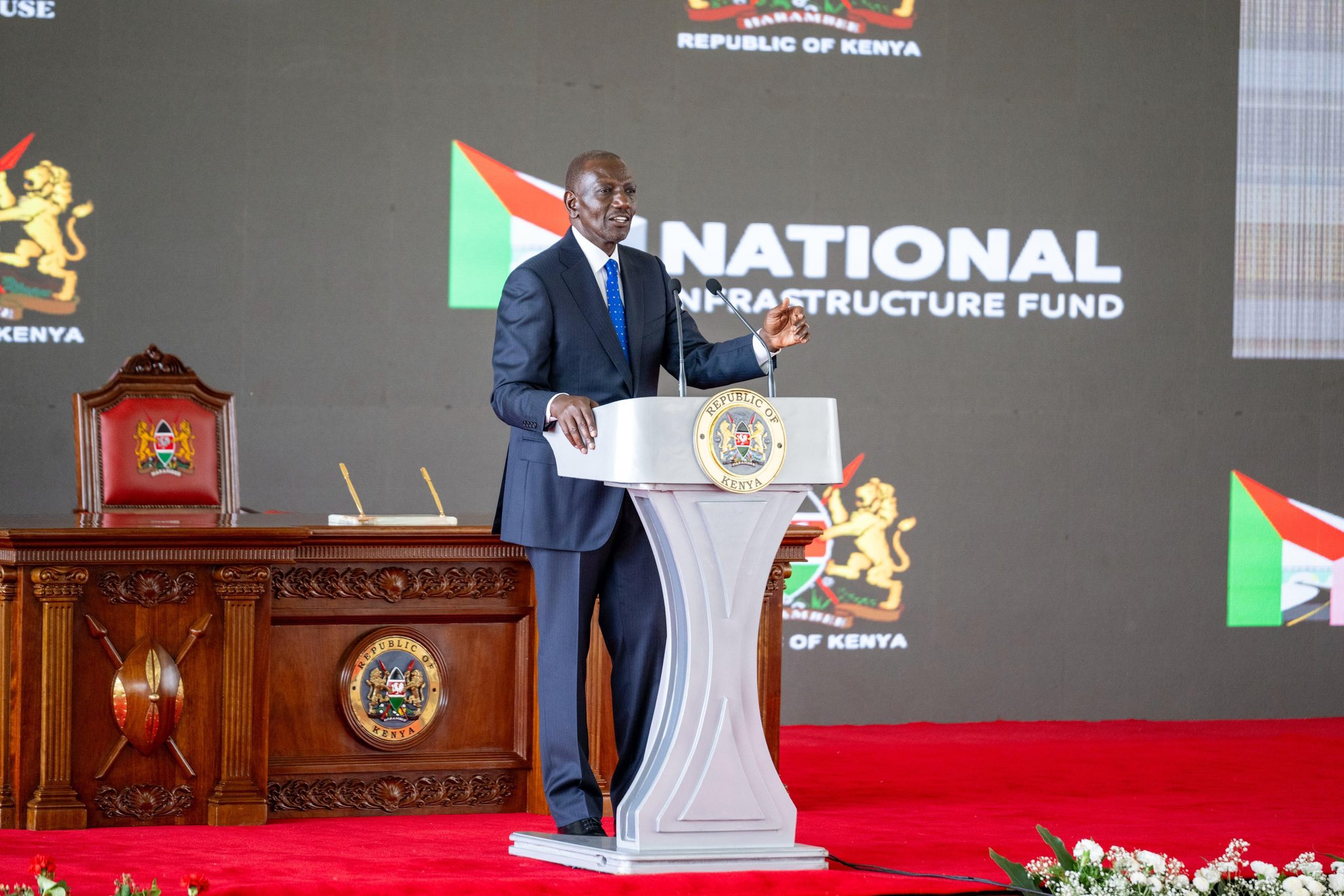
- President William Ruto calls the National Infrastructure Fund (NIF) the most consequential initiative in Kenya’s development history. He insists the fund will empower citizens to become architects of their own future by closing the infrastructure financing gap.
Kenya’s National Infrastructure Fund has been unveiled as a historic breakthrough, promising trillions in new investment and a sweeping transformation of roads, dams, energy, and transport.
Yet beneath the bold vision, critics warn the initiative risks sliding into another politically driven experiment, where weak oversight and unchecked details could erode trust and derail its promise.
President William Ruto calls the National Infrastructure Fund (NIF) the most consequential initiative in Kenya’s development history. He insists the fund will empower citizens to become architects of their own future by closing the infrastructure financing gap.
The plan aims to raise over KSh5 trillion to bankroll flagship projects: 10,000 megawatts of clean energy, 50 mega dams, 200 micro‑dams, more than 1,000 small dams, 2,500km of dual carriageways, and 28,000km of roads.
Financing will also extend the Standard Gauge Railway from Naivasha to Malaba and Kisumu and expand Jomo Kenyatta International Airport.
Read More
“The fund will help us structure our priorities and package them into investable instruments. It will de‑risk our economy by providing a framework that attracts investors rather than merely encourage them,” Ruto declared at State House, Nairobi, during the assent to the National Infrastructure Fund Bill on March 9, 2026.
Treasury and Economic Planning Cabinet Secretary John Mbadi underscores the fiscal reality. Kenya still faces rising infrastructure demands, yet the budget remains constrained.
The fund, he explained, will shift commercially viable projects out of the national budget and into blended financing with private sector capital. This approach reduces the number of projects funded directly by taxpayers, creating fiscal space and limiting the need for new debt.
Still, governance concerns loom. Mukurwe‑ini Member of Parliament (MP) John Kaguchia has warned that the law channels money from parastatals and government assets into uncharted territory with little oversight.
"This infrastructure law is not good for us as Kenyans. First of all, from a governance perspective, it involves taking money from parastatals and government assets into uncharted territory, areas where there is little to no oversight," he said.
Dr. Abraham Rugo the Executive Director of Bajeti Hub has added that Kenya must ask what problem the fund is truly solving, recalling lessons from the Housing Fund and Hustler Fund. He cautioned that long‑term planning risks being overshadowed by short‑term political glory.
“When we debated the new Constitution between 2008 and 2010, we were also approving and launching the first plan for Vision 2030. We knew infrastructure would be essential. Fast forward: we now have a new Constitution, but our politics are structured so that leaders come in, chase glory, and move on. What was meant to be long term planning often turns into short term pushes for raising money,” he added.
Development economist Sheila Olang stresses that the fund must remain separated from politics.
Yet the governance structure, she argued, makes depoliticization unlikely. “Who decides which project comes first? How will it be done? Without fiscal discipline and stronger checks and balances, Kenyans will struggle to trust the process,” she said.
The fund’s ambition is undeniable, but critics warn that the devil lies in the details. Overlooked elements could trigger major issues, undermining the promise of transformative development.
As Dr. Rugo reflected, Kenya’s Vision 2030 was born alongside the new Constitution, yet politics reshaped long‑term planning into short‑term fundraising. He insists development must go beyond infrastructure: quality workers, institutions, and planning matter just as much.
Stay connected with us on WhatsApp and Facebook for instant updates and breaking news as it happens