- While the milestone should have been a victory lap for Africa’s premier human rights body, the sad reality is that it is being systematically starved of the very thing it needs to function. Lack of cooperation by member states.
The African Court on Human and Peoples’ Rights (AfCHPR) recently commemorated its twentieth anniversary of delivering continental justice. The milestone was held as the Court opened its 2026 Judicial Year in Arusha, Tanzania.
While the milestone should have been a victory lap for Africa’s premier human rights body, the sad reality is that it is being systematically starved of the very thing it needs to function. Lack of cooperation by member states.
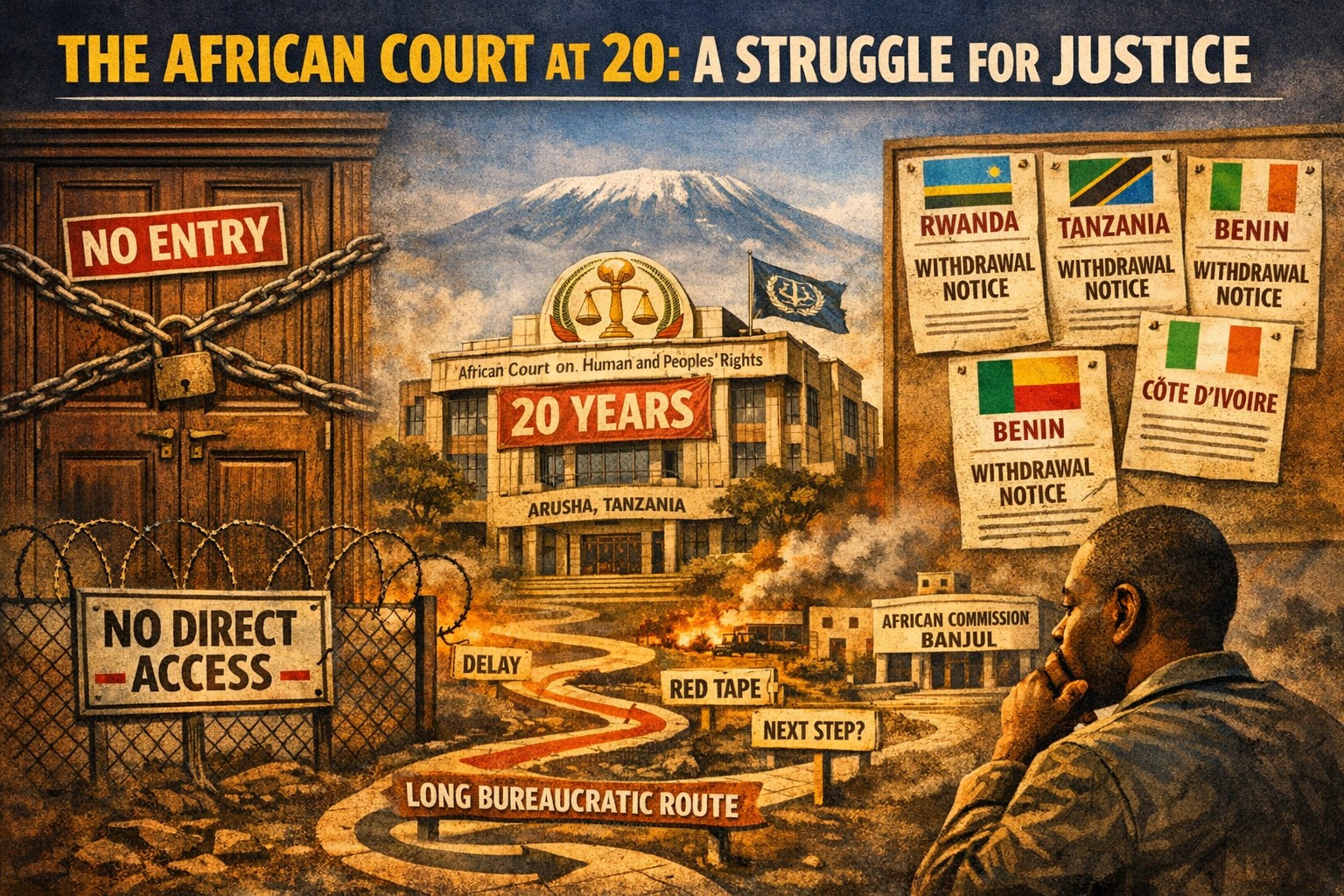
34 African Union (AU) member states have ratified the protocol to join the Court, but ironically, the majority have locked the courtroom doors from the inside by refusing to sign the optional declaration that allows individuals and NGOs direct access. African governments are sending a clear message that they believe in human rights, but not the right for their own citizens to hold them accountable.
Under the current regime, a non governmental organisation (NGO) cannot sue a state directly unless that country has filed a specific optional declaration granting permission. Without it, the route to justice becomes a year-long bureaucratic journey through the African Commission in Banjul before a case can even be considered for referral to Arusha.
Within the corridors of power across the continent, there exists a cynical paradox where leaders champion the rule of law in public while harbouring a deep-seated fear that such a system might actually be applied to themselves.
Read More
Several countries have taken steps to limit the jurisdiction of the African Court by withdrawing the declarations that allow individuals and non-governmental organisations (NGOs) to file cases directly against them.
Between 2016 and 2025, several countries withdrew their declarations under Article 34(6) of the Court Protocol, which allows direct access to the court by individuals and NGOs.
Led by nations like Rwanda, Tanzania, Benin, and Côte d’Ivoire, these states withdrew their declarations to shield themselves from scrutiny.
The alarming withdrawals highlight a logical gap in continental progress. While the Court has handled over 370 cases instrumental in safeguarding the right to life and political participation, its impact is being intentionally hampered. A court’s success requires ratification, implementation, and public awareness.
True sovereignty is not found in the evasion of justice or the silencing of NGOs, but in a system grounded in shared African values. As the AU Commission and Member States reflect on this historic milestone, they must move beyond flowery speeches and address the fact that only a tiny fraction of the 55 member states allow their people direct access to this vital organ.
Stay connected with us on WhatsApp and Facebook for instant updates and breaking news as it happens.