
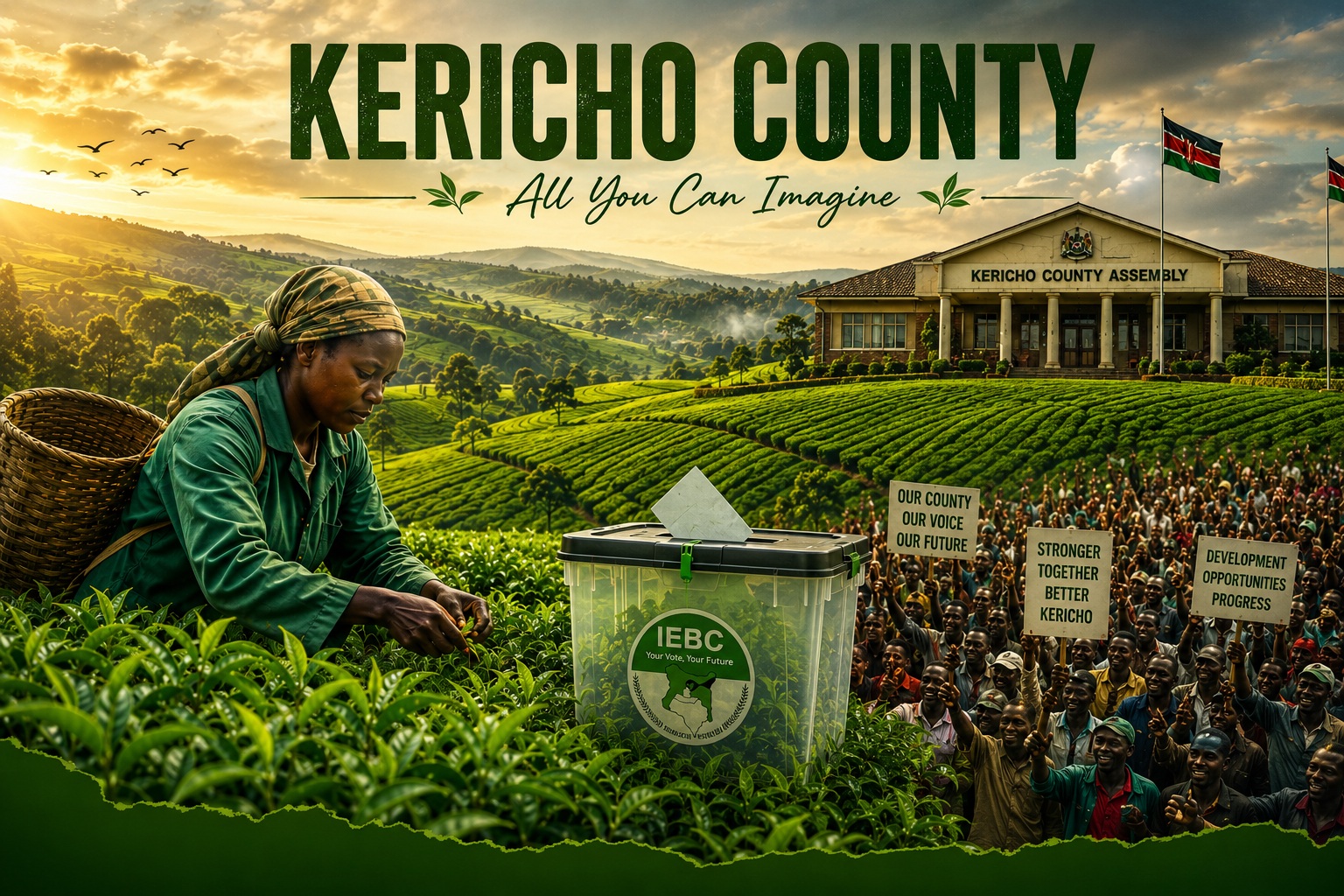
From Kenya's iconic tea plantations to the shifting dynamics of devolved politics, Kericho County stands as one of the South Rift's most influential regions. Discover how agriculture, local leadership, land issues, and economic reforms have shaped elections since 2013—and why the county's tea farmers and growing economy will remain central to the road toward the 2027 General Election.
Kericho County showcases the South Rift Valley of Kenya at its finest. The county offers a rich diversity of attractions, from endless green tea plantations to the culture and heritage of the Kipsigis people. With an area of 2,454.5 km², Kericho had a population of 901,777 in the 2019 census.
It hosts large multinational companies such as James Finlay (through Brown Investments) and Williamson Tea Kenya, which manage the vast fields alongside local processors like Kenya Tea Packers (Ketepa). Smallholdings, dairy cattle farming, and sugarcane cultivation—especially in the lower Soin area—provide significant household livelihoods for locals. This agricultural base remains a key determinant of economic and political affairs.
Political Landscape: 2013–2022
Read More
2013 General Election
Prof. Paul Kiprono Chepkwony of the URP won the governorship with 181,862 votes. His closest challenger was Charles Davy Kipngetich Arap Kirui of KANU with 31,254 votes.
Charles Keter (URP) won the Senate seat with 201,363 votes, while Richard Kipkemoi Too (NVP) finished as the distant runner-up.
2017 General Election
Prof. Paul Kiprono Chepkwony retained his seat under the Jubilee Party, garnering 287,511 votes while Jonah Kipkemoi Keter of KANU came second with 14,392 votes.
Aaron Cheruiyot (Jubilee) secured the Senate seat with 278,059 votes, defeating KANU's Paul Sang who received 25,124 votes.
2022 General Election
Dr. Erick Mutai of the United Democratic Alliance (UDA), who has survived an impeachment attempt in August 2025, secured the governorship with 316,768 votes. Dr. Mutai had earlier defeated Charles Keter in a highly competitive UDA primary by 126,038 votes to 60,342 votes.
Aaron Cheruiyot (UDA) retained his Senate seat with 292,295 votes, beating Independent runner-up Queenas Chepkemoi who got 36,876 votes.
Following the onset of Devolution in 2013, county-level politics became highly competitive. Attention heavily shifted toward intra-party nomination battles. Smallholder farmers make up the main voting constituency, meaning local representatives work hard to secure farm subsidies, fair land-use policies, and balanced deals with multinationals. Discontent over historical land ownership remains a source of friction.
Members of Parliament by Constituency
| CONSTITUENCY | MPS | PARTY |
| Soin/Sigowet | Justice Kemei | UDA |
| Kipkelion West | Hillary Kosgei | UDA |
| Kipkelion East | Joseph Cherorot | UDA |
| Bureti | Kibet Komingoi | UDA |
| Belgut | Nelson Koech | UDA |
| Ainamoi | Benjamin Langat | UDA |
Economy and Infrastructure
Other recent flashpoints include the 0.8% levy on tea exports implemented in 2026. Governor Mutai and local farmers have strongly petitioned the Tea Board of Kenya to abolish this policy. Furthermore, automated harvesting methods used by multinationals have resulted in local job losses and labor demonstrations. A 2025 committee of inquiry suggested a balanced mechanisation-to-manual framework to protect local livelihoods.
Environmental pressures also threaten the Mau Forest complex, which serves as Kericho's primary water tower. To counter this, the county is utilizing its Sh1.2 billion development budget to support roads, healthcare, MSMEs, industrial parks, and climate change adaptation initiatives, including the widespread distribution of certified tree seedlings.
Do you have updates & corrections about this constituency? If you have information that should be captured, or notice data that has changed or is inaccurately presented, kindly write to us at [email protected].


-1784793396-md.jpg)
 (1)-1784794030-md.jpg)



-1784793396-sm.jpg)
 (1)-1784794030-sm.jpg)